

By Dayvon Rose
What does the stage mean to you? An Act of Living.
What does the stage mean to you? Is it just a place where performances happen, songs are sung, stories are told, or is it something more? Throughout my life, I have been on and around the stage. It was a place filled with many kinds of discoveries. I learnt what it meant to commit to a goal; I discovered how to open my mind to a new creative side; and, more importantly, I found my voice. My first time at the stage was back in Shaker Heights High School, where students from all walks of life were encouraged to explore theatre in their own way. While they performed a wide variety of works, from Shakespeare to classic musicals like Les Misérables, students had even more options. They also offered classes for stagecraft, stage managing, movement, playwriting, and more.
Despite having the opportunity to explore multiple paths in theatre, I still chose to abandon my creative side when I came to Tri-C. I believed I had finally broken out of my shell and was ready to pivot to bigger things, only to realize I never broke out at all. Because of the community I was a part of in High School, I was consistently encouraged to take leaps that I was too afraid to do on my own. Years later, I found myself taking Acting classes and renewing my love for the arts. The late Brian Zoldessy was my professor, and he saw something in me that I still struggle to see. With his guidance, I not only reclaimed my voice but used it to lead the 2018 production of In the Heat of the Night. Though, due to personal reasons, I was unable to continue with acting and had to focus on my personal life. However, while taking classes, I met a staff member, Terrii Zernechel, who advised the Eastern Campus’ Drama Club. I joined with my friend and eventually became the President.
This brings me to the present, where after many changes, classes and opportunities in theatre have declined. While there could be multiple reasons for this, what remains of the Theatre department is only a shell of what it used to be. When I returned to Tri-C years later, I learned of this and wanted to push for change. After finding out that Terrii still worked on Campus, as the
Scheduling Specialist, I wanted to bring her back into the fold, and together we rebuilt the Drama Club. When I spoke to Terrii about the changes over the years and the decrease in Theatre activities, she told me, “It was a bummer when losing access to resources and people within the department during COVID.” She then explained further, “There wasn’t really an interest, and Brian retired; there was no central instructor who created that world. The department became more adjunct, and theatre positions are different almost every year now.”
Terrii, who was the Lead Theatre Technician during my time in the theatre department, commented on why she wanted to start a Drama Club back in 2018. “When I first came on board full time, they were starting to branch out. Trying to expand it to East and Metro. I didn’t know any of the students, and we didn’t do shows often. I wanted to build a better structure in the department. Wanted to see if there was any interest. Also, Brian did not have enough time and energy to put into the drama club.”
Something Terrii said stuck out to me: “I wanted to see if there was any interest”. When you watch movies and TV shows that highlight creative arts, one common trope is defunding those arts. Whether it’s classes being removed, jobs within the theatre department being lost, or the department losing funding altogether. You will typically see the higher-ups make the case that there is little to no interest in the arts or how little value it may bring. Whatever the reasons, it always comes down to the idea it offers little benefit. Even I was told that starting a Drama Club could be fruitless, since students might not demand it. Though I was discouraged at first, that didn’t stop me. I knew what it felt like to yearn for something where there is nothing, and I wagered others felt the same. All it takes is a spark to ignite the flames of creativity, and I was willing to be the spark if needed. Sure enough, there was interest everywhere I went, and as I spread awareness of the club, more people showed their support and interest.
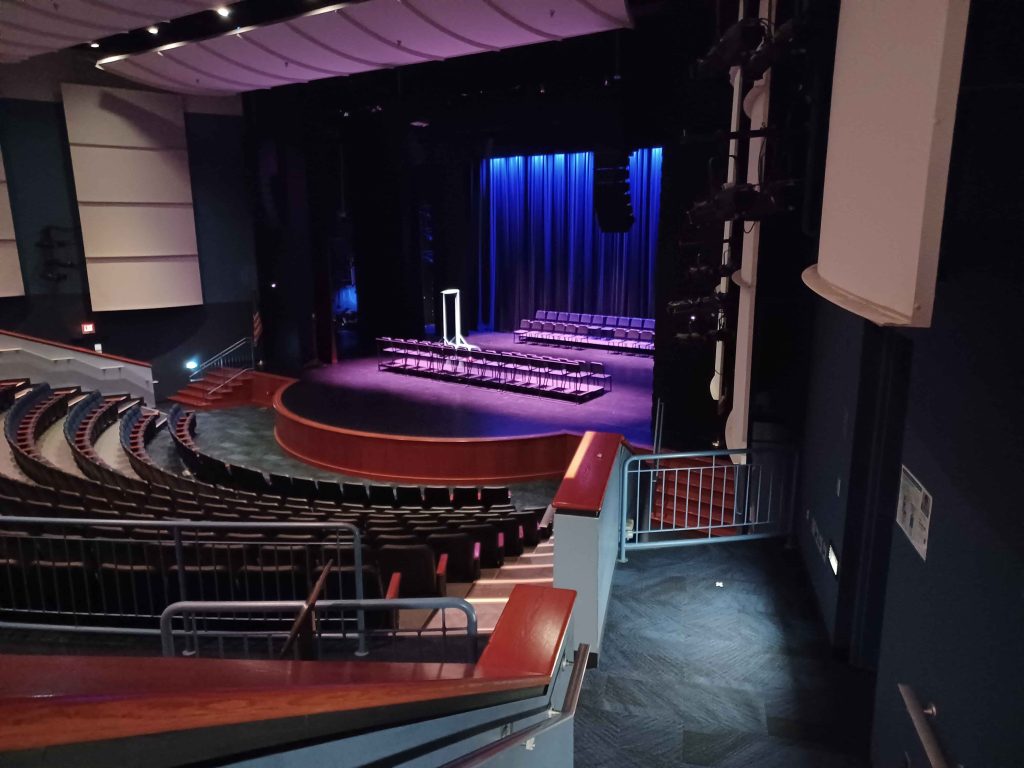
Recently, we held a performance ont East Campus called Pressure Points: A ten-minute play festival that I participated in. It featured 10 short-act plays that each dealt with a struggle or deep conflict the protagonist(s) were feeling. Ricky Quintana directed these plays and students of Tri-C, as well as the Dean of Student Affairs, performed them. Since this was the first production I’ve ever been a part of since 2018, I was nervous. I only auditioned because my Drama Club Vice President pushed me to do so to show out for the club. Despite the short production schedule, I grew close to my castmates and found even more reason to campaign for not only the Drama Club, but for the arts. When I first saw what the stage would look like, I asked myself, “What does the stage mean to you?”. The cascading blue lights dashing across the stage, the chairs assembled side by side, and the archway used to transition an actor/actress into their character. I was reminded of the magic that not only blessed the stage, but that was inside me too.
Two individuals I had the pleasure of working on stage with were E’mia Gray and Ria Puri; the latter wants to start their own club. E’mia, who played the role of Nova in the play Mirrors, is currently studying Liberal Arts and is hoping to use her education here at Tri-C, pursuing auditions in Film, plays, and TV shows. When asked what the stage means to you, she responded: “The stage means a moment of another world somewhere to get away, relief, unlimited expression that may not be able to be expressed on a day to day basis.” When I asked her how she heard about the opportunity, she told me that Ricky Quintana was her teacher for both Theatre Appreciation and Acting 1. She had received an email and was encouraged to audition for the production. “Wow, I can’t believe this is here at the Eastern Campus”, she said. Because the stage means something different to others, I asked how she transitions into her role. “It feels like it’s a moment of on/off, but it also feels like it comes naturally. When I act, it’s something relatable to the character that I connect to”, she replied. After the production, E’mia joined the Drama Club and expressed interest in exploring the different writing mediums. She said, “I would like to see a writing group that surrounds playwriting, songwriting, and poetry.”
Ria Puri, who is currently studying nursing, played Depression in Mirrors and Zoey in Fly. She’s always appreciated the arts and the opportunity to express herself creatively as a child. “It reminded me how important creativity, self-expression, and having a sense of community are in our lives,” she said. For Ria Puri, the stage represents freedom and a sense of belonging. She told me, “It’s a place where I can let go of the outside world, embrace who I am, and share a part of myself with others.”. Since moving to Ohio, she has wanted to find a community where she truly feels accepted, as it meant a lot to her. “It’s helped me realize that sometimes, finding the right environment can bring out parts of yourself you never knew you were capable of expressing.”, she said. When asked how she gets into the role, she mentioned how it goes beyond memorizing lines or performing on stage. She tries to connect with the character’s emotions and experiences and understand their motivations. She also wants to start an Orchestra club for both beginner and experienced musicians. By creating an inclusive space for others to learn, play together, and potentially organize nonprofit performances/events, she hopes to help others discover their passions and feel a sense of belonging. “If anyone is interested in joining or helping bring this orchestra club to life, I would love to connect with them! You can contact me via student email at S01276536@acad.tri-c.edu.”
As for me, my goals and aspirations align with people like Terrii and Ria Puri. I have always wanted to create an inclusive space that doesn’t require certain level of experience or skill. At its core, I believe theatre arts are about sharing a story with another. What matters is that every story has a lesson and a meaning behind it. As the famous playwright William Shakespeare said, “All the world’s a stage.” As I lead the Drama Club, I want everyone regardless of how they choose to tell their story, to feel heard. Telling a story requires actors, playwrights, costumers, lighting techs, stagehands, directors, managers, and much more. Some students may wear multiple hats and want to write plays and/or act in them, while others might want to direct them. I hope to create that space where everyone has a part to play. So, to me, the stage means so much more than I can list. It can be a teacher, a friend, a story, a hope, a fear, but most importantly, a chance for whoever is willing to traverse it.
To join the Drama Club, reach to me: S01118234@acad.tri-c.edu

